حمّل القصص مجاناً وابدأ مغامرتك مع طفلك الآن!


You’ve just spent the morning calling local suppliers, and you finally hear it: a rock-bottom per-gallon quote that sounds like a massive win for your winter heating budget. You eagerly sign the contract, schedule your first fill, and wait for the invoice.
But when you open the bill, your stomach drops. Suddenly, that “cheap” fuel isn’t so cheap anymore.
What happened? You just collided with the difference between the quoted per-gallon rate and your true all-in cost.
Because the residential market is highly competitive, many suppliers use aggressive “teaser rates” to get a foot in the door—literally. Once they have locked you into a contract and placed their tank on your property, they make up for that low promotional price on the back end. They do this by burying a labyrinth of surcharges, administrative penalties, and equipment lease costs deep within the fine print.
By the time you take your final bill and divide it by the actual gallons delivered, your all-in cost can easily be 20% to 30% higher than the per-gallon price you were originally quoted.
Navigating a residential contract shouldn’t require a law degree. In this guide, we are pulling back the curtain on these billing practices. We will break down the most common hidden fees buried in residential agreements, explain what triggers them, and show you exactly how to negotiate or avoid them completely.
The 7 Most Common Hidden Propane Fees (And How to Avoid Them)
When reviewing a contract, don’t just skim for the price per gallon. Flip to the terms and conditions or the fee schedule page.
Here are the seven most common line items designed to inflate your bill, along with exact strategies to bypass them.
1. Delivery and Fuel Surcharges
Suppliers often tack a flat fee onto every delivery to protect themselves against fluctuating diesel prices and the logistics of routing heavy trucks. While it sounds reasonable on the surface, these fees frequently remain high even when oil prices drop.
- How to avoid it: Ask providers if they waive delivery fees for customers enrolled in an Automatic Delivery plan. Because automatic delivery allows the company to optimize its routes efficiently, they are often willing to drop or heavily discount this surcharge.
2. Minimum Use Fees (The Low-Volume Penalty)
This is one of the most frustrating surprises for energy-conscious homeowners or those who only use propane for a single appliance, like a fireplace or a cooktop.
If you don’t burn a predetermined amount of fuel annually—frequently 1.5 to 2 times the capacity of your tank—the supplier will hit you with a flat “minimum use” penalty to compensate for the lack of delivery volume.
- How to avoid it: When setting up service, ensure your tank size accurately matches your consumption. If you only use propane for cooking, request a smaller 100-gallon tank rather than a standard 500-gallon tank. Alternatively, look for a supplier that explicitly states they do not charge minimum usage penalties.
3. Tank Rental and Lease Fees
If you don’t buy your tank outright, you are renting it from the company. This usually incurs an annual lease fee ranging from $50 to $150. While this pays for the equipment, the real “hidden” cost is the legal restriction that comes with it: when you rent a tank, no other company is permitted to fill it. This completely strips away your ability to shop around for better market rates.
- How to avoid it: The ultimate solution is tank ownership. Purchasing a tank requires an upfront investment ($1,500 to $3,500 depending on size and installation), but it eliminates the annual lease fee entirely and grants you total freedom to buy fuel from whoever has the lowest price.
4. HAZMAT and Safety Compliance Fees
You will see this on almost every invoice under names like “HAZMAT Fee,” “Safety Compliance Fee,” or “Regulatory Recovery Charge.” Companies claim these fees offset the cost of mandatory government compliance, employee safety training, and specialized vehicle inspections.
- How to avoid it: Because these relate to strict regulations, they are rarely completely waived. However, you should check whether the supplier has transparent pricing. A reputable supplier should be able to tell you upfront exactly what this flat fee is, rather than masking it as a shifting percentage of your total bill.
5. Pump-Out and Tank Removal Fees
Decide to cancel your service or switch to a competitor? Be prepared for the exit penalty. If you are renting your tank, your current supplier will charge heavy labor fees to dig up or pick up their tank. Even worse, if there is fuel left in the tank, they will charge a pump-out fee (often per gallon) to safely drain it.
- How to avoid it: Carefully timing your transition is key. If you plan to switch suppliers, transition your service during the late spring or summer when your usage is lowest, and run the tank down as close to empty as safely possible (around 5% to 10%) before terminating the agreement.
6. Emergency Delivery and Will-Call Fees
If you prefer to monitor your own tank level, you are a “Will-Call” customer. However, if you forget to check the gauge, run completely out of fuel, and need an immediate delivery on a weekend, holiday, or after hours, you will face massive emergency dispatch fees. These can easily add $100 to $250 to a single delivery.
- How to avoid it: Switch to an Automatic Refill Program. Most suppliers monitor your usage using a smart tank monitor or algorithmic “degree-day” tracking, guaranteeing you never run out while entirely bypassing emergency dispatch costs.
7. System Leak Test Fees
By federal safety laws, if your tank runs completely out of fuel and the pressure drops to zero, the lines must undergo a professional system leak test before a technician can safely restart your gas flow. Suppliers will pass this labor cost directly to you, usually charging $50 to $100 for the inspection.
- How to avoid it: If you are a Will-Call customer, never let your tank level drop below 20% capacity. Call for a delivery as soon as your gauge hits that mark to keep the system pressurized and avoid triggering a mandatory leak test.
Should You Rent or Own Your Propane Tank?
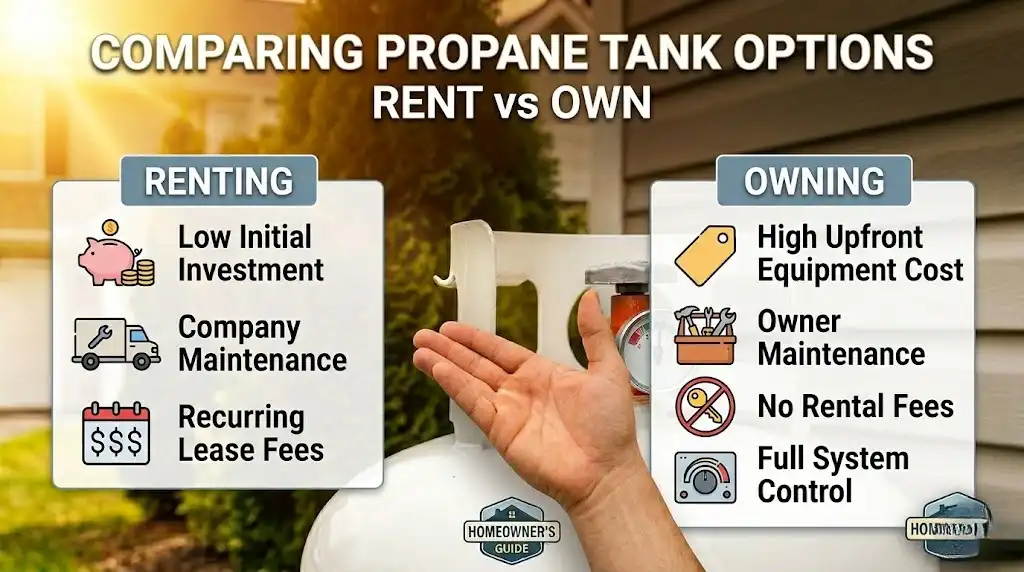
The single biggest factor in determining your long-term propane costs is whether you lease your storage tank from a supplier or own it outright. While renting seems like the path of least resistance, it is often the gateway to the hidden fees discussed above.
Here is a breakdown of how the two options compare:
| Feature | Renting a Tank | Owning a Tank |
| Upfront Cost | Very low (often just a delivery/set fee) | High ($1,500–$3,500 for tank and installation) |
| Annual Fees | $50–$150 per year | $0 |
| Minimum Use Penalty | Highly likely | None |
| Supplier Choice | Locked into one company | Complete freedom to shop around |
| Fuel Pricing | Subject to higher “captive” rates | Access to competitive, open-market pricing |
| Maintenance | Covered by the supplier | Homeowner’s responsibility |
The Return on Investment (ROI) of Ownership
The upfront cost of purchasing a tank can cause sticker shock, but the ROI often makes it the smarter financial move.
When you rent a tank, the supplier owns the equipment on your property. Legally, no other company is allowed to fill it. Because they have a monopoly on your supply, they rarely offer their most competitive per-gallon rates after the first promotional fill.
Conversely, when you own the tank, you can call three different local suppliers and ask for their daily rate, forcing them to compete for your business. Between securing lower per-gallon prices, avoiding annual lease fees, and escaping minimum usage penalties, the tank often pays for itself within three to five years.
To see how these costs compound over time, use this interactive calculator to map out the break-even point for your specific situation:
Key Insight: If you only use propane for a cooktop or a single fireplace (low volume), purchasing a smaller, 100-gallon tank is almost always the better choice to avoid punishing minimum-use fees.
How to Negotiate a Better Propane Contract
Knowing about hidden fees is only half the battle; the other half is actively negotiating them out of your agreement before you sign on the dotted line. The residential propane market is highly competitive, and suppliers often have the flexibility to adjust terms if it means securing a reliable, long-term customer.
Here is your step-by-step game plan for securing the best possible contract:
1. Request Fee Waivers Upfront
Don’t be afraid to ask a sales representative to strike specific line items from your agreement. While some charges are non-negotiable, others are completely at the supplier’s discretion.
- Target the delivery fee: Offer to sign up for their automatic routing plan in exchange for permanently waiving the per-delivery surcharge.
- Negotiate the tank lease: If you choose to rent, ask for the first year’s lease fee to be waived as a sign-on bonus. If you are a low-volume user, insist on a smaller tank to ensure you won’t get hit with minimum-use penalties.
2. Choose the Right Pricing Plan
Your contract will dictate how your fuel is priced throughout the year. Choosing the right structure can save you hundreds of dollars when winter demand spikes:
- Fixed-Rate (Lock-In): You pay a set price per gallon for the entire season. This protects you from massive price spikes during deep freezes, though you won’t benefit if market prices drop.
- Variable-Rate (Market Price): Your price fluctuates with the current market. This is inherently risky; while summer fills are cheap, winter fills can be brutally expensive.
- Pre-Buy: You purchase your estimated annual gallons upfront during the summer months when prices are historically at their lowest.
3. Demand the “All-In” Price in Writing
Never accept a verbal per-gallon quote as the final word. Ask the supplier to send you a sample invoice based on a standard 100-gallon delivery. This forces them to itemize every surcharge, HAZMAT fee, and administrative cost, revealing your true all-in cost before you commit.
4. Leverage Local Competitors
Call at least three different suppliers in your local area. If Company A has a great per-gallon rate but high fees, and Company B has a slightly higher rate but zero fees, use that information. Show Company B the competitor’s quote; many independent suppliers will happily match or beat a rival’s all-in price to win your business.
5. Scrutinize the Exit Clause
Before signing, flip straight to the termination section. Check exactly what it will cost to leave the company in a few years. Ensure the pump-out fees and tank removal fees are explicitly capped at a reasonable flat rate so you aren’t held hostage by exorbitant labor charges when you eventually decide to switch providers.
The Bottom Line
Securing a reliable propane supplier shouldn’t feel like navigating a minefield of surprise charges. While the quoted per-gallon rate is the flashy number that gets you in the door, it’s the fine print that determines what actually comes out of your bank account.
By calculating your true all-in cost, considering the long-term benefits of tank ownership, and boldly negotiating fee waivers upfront, you can take control of your winter heating budget.
Remember: you are the customer. In a highly competitive residential market, you have the power to walk away from bad terms. Always read the contract, do the math, and never settle for a “cheap” introductory rate that ends up costing you a fortune in the long run.
Ready to check your rates?
Ready to stop guessing and start negotiating? Don’t let a supplier tell you their rate is the “best in town”—verify it yourself.
Before you make your next round of calls or sign a new agreement, check the current market data to know exactly what you should be paying.
Head over to lpgpricetoday.com to track the latest state-by-state propane prices in the US. Having accurate, up-to-date pricing data in your back pocket is the ultimate leverage you need to bypass hidden fees and secure a fair, transparent contract.